Description
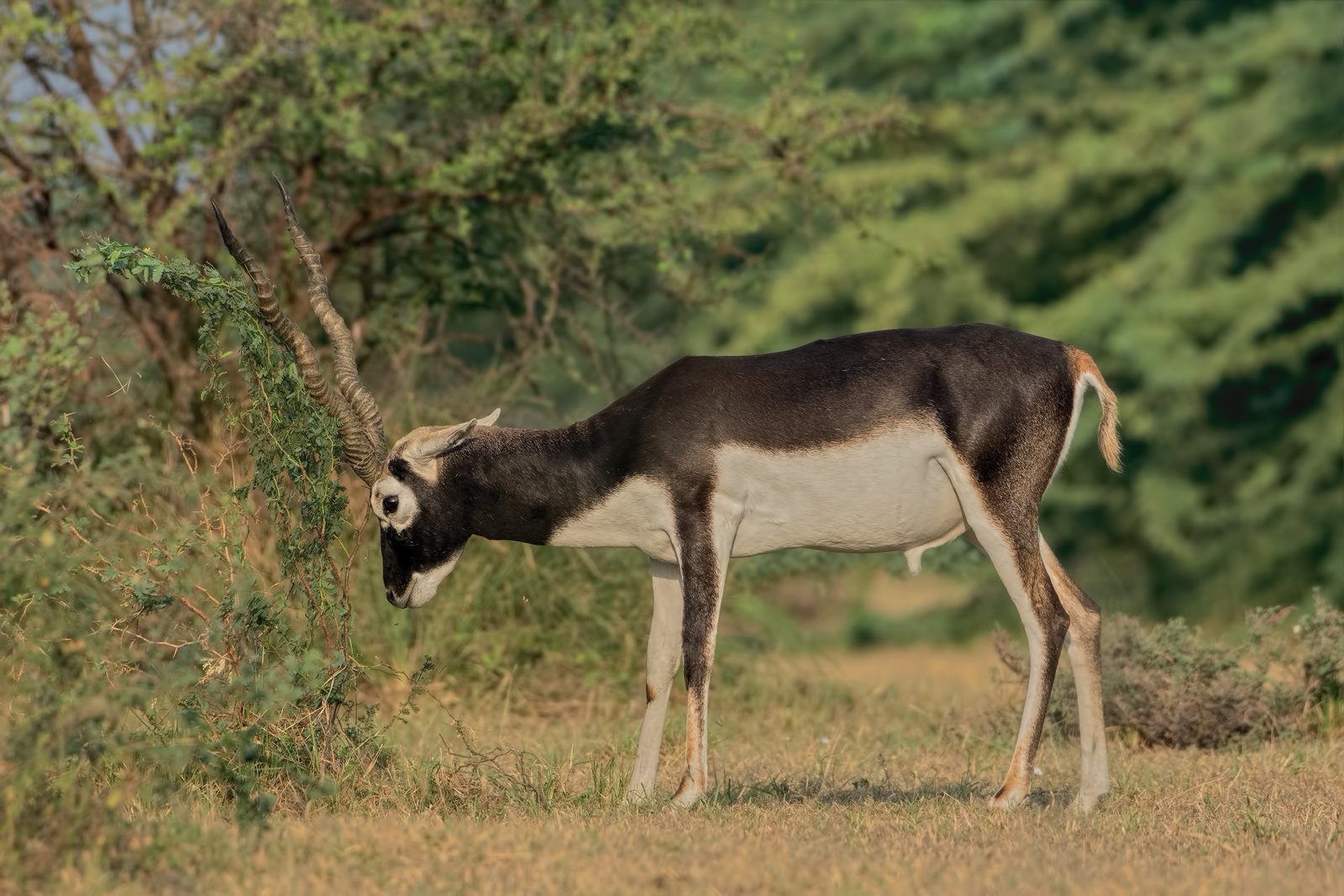
The Indian Blackbuck (Antilope cervicapra) is one of India’s most recognizable grassland mammals. This original wildlife photograph features a male Blackbuck captured in its natural environment by wildlife photographer Amarjeetsinh Jhala.
With its contrasting dark and white coat, elegant body shape and characteristic spiral horns, the male Blackbuck is one of the most striking antelopes found in India.
This photograph is part of the Focused Nature By AJ collection of original Indian wildlife and nature photography.
About the Indian Blackbuck
The Blackbuck (Antilope cervicapra) is a medium-sized antelope belonging to the family Bovidae. It is the only surviving species in the genus Antilope.
The species is native to the Indian subcontinent and is particularly associated with open landscapes. Blackbucks can be found in grasslands, open scrublands, agricultural areas and other habitats with relatively little dense vegetation.
Male Blackbuck
Male Blackbucks are visually different from females.
As males mature, their upper body coloration becomes progressively darker, ranging from tawny brown to deep brown or almost black. Their underparts remain white, producing the characteristic black-and-white appearance for which the species is famous.
Adult males also develop impressive spiral horns, which can reach approximately 79 cm in length.
The combination of the dark coat, white facial markings, white underparts and spiral horns makes the male Indian Blackbuck an exceptional subject for wildlife photography.
Identifying a Male Blackbuck
A male Indian Blackbuck can be recognized by several distinctive characteristics:
- Dark brown to black upper body
- White underparts
- White markings on the face and around the eyes
- Long, slender legs
- Streamlined body
- Long spiral horns
- Short tail
- Characteristic antelope profile
The dark coloration generally becomes more intense as males mature.
Habitat of the Indian Blackbuck
Blackbucks are strongly associated with open grasslands and other open habitats.
They can occur in:
- Short grasslands
- Open plains
- Semi-arid landscapes
- Open scrublands
- Agricultural margins
- Lightly wooded areas
They generally avoid dense forests and are particularly suited to landscapes where open visibility allows them to detect predators.
Blackbuck populations occur across many parts of India, including Gujarat, Rajasthan, Madhya Pradesh, Maharashtra, Karnataka and other states.
Blackbuck Behaviour
Blackbucks are primarily diurnal antelopes, meaning they are active during daylight hours.
They are social animals and can occur in groups, although group composition and size can vary depending on habitat, food availability and season.
During the breeding season, males can establish territories and display territorial behaviour. Male competition may involve vocalizations, displays and confrontations using their horns.
Blackbuck Speed and Agility
The Blackbuck is renowned for its speed and agility.
Its streamlined body and long legs are well suited to rapid movement across open grassland. The ability to run quickly is an important adaptation in open environments where there is limited vegetation available for concealment.
This combination of speed, elegance and distinctive appearance makes the Blackbuck one of India’s most exciting mammals to observe and photograph.
Diet
Blackbucks are herbivores and primarily feed on grasses and other vegetation.
They may also use agricultural landscapes and consume cultivated crops and other available plant material.
Indian Blackbuck Conservation
Although the Blackbuck is currently categorized as Least Concern on the IUCN Red List, its populations and habitats face local conservation challenges. In India, the species receives the highest level of legal protection under Schedule I of the Wildlife (Protection) Act.
Habitat loss and fragmentation are important concerns for Blackbuck populations. Recent research has highlighted the continuing fragmentation of grassland habitats and the importance of maintaining open ecosystems for Blackbuck conservation.
A 2025 review also documented substantial changes in Blackbuck distribution and population trends in Rajasthan, demonstrating the importance of continued monitoring and habitat conservation.
Blackbuck in Gujarat
Gujarat is one of the important Indian states for Blackbuck conservation.
Blackbuck National Park, Velavadar, is one of India’s best-known protected areas for the species. Research by the Wildlife Institute of India has specifically examined Blackbuck habitat use and activity patterns at Velavadar National Park in Gujarat.
The open grassland environment of Gujarat provides important habitat for this iconic Indian antelope.
Indian Blackbuck Wildlife Photography
The male Blackbuck is an excellent subject for wildlife photographers because of its distinctive appearance and behaviour.
Its dark coat contrasts strongly against open grassland, while the spiral horns provide a recognizable visual feature. Photographs can document not only the animal itself but also the importance of India’s remaining grassland ecosystems.
This original photograph was captured by wildlife photographer Amarjeetsinh Jhala and forms part of the Focused Nature By AJ Indian wildlife photography collection.
Photography Details
Common Name: Indian Blackbuck / Blackbuck
Scientific Name: Antilope cervicapra
Family: Bovidae
Animal Type: Antelope / Mammal
Sex: Male
Habitat: Grasslands, Open Scrub and Semi-Arid Landscapes
Diet: Herbivore
Activity: Diurnal
Location: India
Photographer: Amarjeetsinh Jhala
Photograph Type: Wildlife Photography
Conservation Information
IUCN Red List: Least Concern
Indian Legal Protection: Schedule I under the Wildlife (Protection) Act
Although its global IUCN category is Least Concern, habitat fragmentation and loss of suitable open ecosystems remain important conservation concerns for Blackbuck populations in India.
About This Photograph
This is an original wildlife photograph captured in the wild by wildlife photographer Amarjeetsinh Jhala.
The image is part of the Focused Nature By AJ collection documenting India’s birds, mammals, reptiles and other wildlife through original nature photography.
This photograph can be licensed for approved personal, commercial, editorial, educational, conservation and printing applications according to the selected license.
Image Licensing
Personal Use
Suitable for personal collections, wallpapers and other approved non-commercial applications.
Commercial Use
Suitable for websites, digital marketing, advertising, social media, business presentations and other approved commercial applications.
Printing & Publication
Suitable for magazines, books, newspapers, calendars, educational publications, exhibitions and other approved editorial and printing uses.
Explore More Indian Wildlife Photography
Explore more original Indian Blackbuck photographs, male Blackbuck photography, Indian antelope photography, grassland wildlife photography, Indian mammal photography and Indian wildlife photography captured by Amarjeetsinh Jhala.
Focused Nature By AJ documents India’s birds, mammals, reptiles and wildlife through original nature photography, with selected photographs available for personal, commercial and printing & publication licensing.
Reviews
There are no reviews yet.